Common ventilator alarm functions:What are the main alarm functions on a common ventilator?
Q: What are the main alarm functions on a common ventilator?
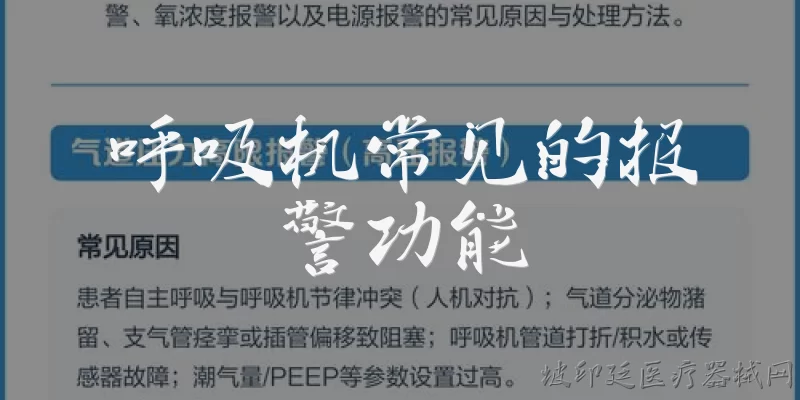
A: Common ventilator alarms include high and low pressure, low tidal volume, low minute ventilation, apnea, high respiratory rate, and low oxygen saturation. High pressure alarms signal increased airway resistance or compliance issues. Low pressure alarms may indicate circuit disconnection or leaks. Low tidal volume or minute ventilation alarms warn of inadequate ventilation. Apnea alarms detect absent spontaneous breathing. High respiratory rate alarms flag tachypnea or auto-triggering. Oxygen saturation alarms alert to hypoxemia. These alarms help clinicians quickly identify and correct potentially dangerous situations, ensuring patient safety during mechanical ventilation.
Q: How does a high pressure alarm work on a ventilator?
A: A high pressure alarm activates when airway pressure exceeds a preset limit, typically 40 cm H2O in adults. It indicates increased resistance or decreased compliance, such as from secretions, bronchospasm, pneumothorax, or patient-ventilator asynchrony. The ventilator may cycle off inspiration early or switch to a lower pressure. The alarm alerts the clinician to suction the airway, check for kinks or water in tubing, assess breath sounds, and adjust settings. Ignoring a high pressure alarm can lead to barotrauma or inadequate ventilation, so prompt evaluation is essential.
Q: What is the purpose of a low tidal volume alarm?
A: A low tidal volume alarm alerts when exhaled tidal volume falls below a set threshold, often 10-20% of the target. It indicates hypoventilation from leaks, disconnection, decreased compliance, or patient fatigue. Leaks can occur in the circuit, endotracheal tube cuff, or chest tubes. Decreased compliance may result from pneumonia, pulmonary edema, or abdominal distension. The alarm prompts checks for circuit integrity, cuff pressure, and patient status. It helps prevent hypercapnia and respiratory acidosis by ensuring adequate ventilation.
Q: Why is an apnea alarm important on a ventilator?
A: An apnea alarm detects absence of spontaneous breaths within a set time, typically 15-20 seconds for adults. It is crucial in modes like CPAP or PSV where the patient initiates breaths. If apnea occurs, the ventilator may switch to a backup mode or initiate mandatory breaths. Causes include oversedation, neurological injury, or respiratory muscle fatigue. The alarm ensures continuous ventilation and prevents hypoxia or hypercapnia. Clinicians should assess the patient's drive, sedation level, and readiness for weaning to address the underlying cause.
Q: How do oxygen saturation alarms function on ventilators?
A: Oxygen saturation alarms integrate with pulse oximetry to monitor SpO2, typically triggering below 90-92%. They alert to hypoxemia from worsening lung function, mucus plugging, or ventilator malfunction. Some ventilators also have high SpO2 alarms to prevent oxygen toxicity. When activated, clinicians should check the waveform, patient color, and breath sounds, then increase FiO2, suction, or adjust PEEP. These alarms help maintain adequate oxygenation and prevent tissue hypoxia, but false alarms from motion or poor perfusion require verification before intervention.
Words of experience
Common scenarios of "Common ventilator alarm functions"
【Nurse】 Hey, I noticed the ventilator alarm went off earlier. What was that about?
【RT】 That was a high-pressure alarm. It usually means something is blocking the airway or the patient is coughing.
【Nurse】 I see. What should I do if it goes off again?
【RT】 First, check the patient. Are they in distress? Then look for kinks in the tubing or secretions.
【Nurse】 Got it. And what about the low-pressure alarm? I've heard it a few times.
【RT】 Low-pressure alarm often indicates a leak or disconnection. Check all connections and the cuff pressure.
【Nurse】 So if I hear low pressure, I should first check for disconnection?
【RT】 Exactly. Also, if the patient is on a mask, check for leaks around the mask.
【Nurse】 What about the apnea alarm? That one really scared me.
【RT】 Apnea alarm means the patient hasn't taken a breath within the set time. It's critical. Check the patient immediately.
【Nurse】 Should I bag them if they're not breathing?
【RT】 Yes, if the patient is apneic, start manual ventilation with a bag and call for help.
【Nurse】 Okay. Are there other alarms I should know about?
【RT】 Yes, there's the high respiratory rate alarm, low minute volume, and high tidal volume. Each has its own causes.
【Nurse】 That's a lot. Can you give me a quick rundown?
【RT】 High rate might be due to pain or anxiety. Low minute volume could be from shallow breaths. High tidal volume might be from over-ventilation.
【Nurse】 Thanks. I'll keep an eye on those. Should I document every alarm?
【RT】 Yes, document the alarm, what you found, and what you did. It's important for patient safety.
【Nurse】 Will do. I appreciate the explanation. I feel more confident now.
【RT】 No problem. Remember, if you're unsure, call me or the on-call RT. We're here to help.